
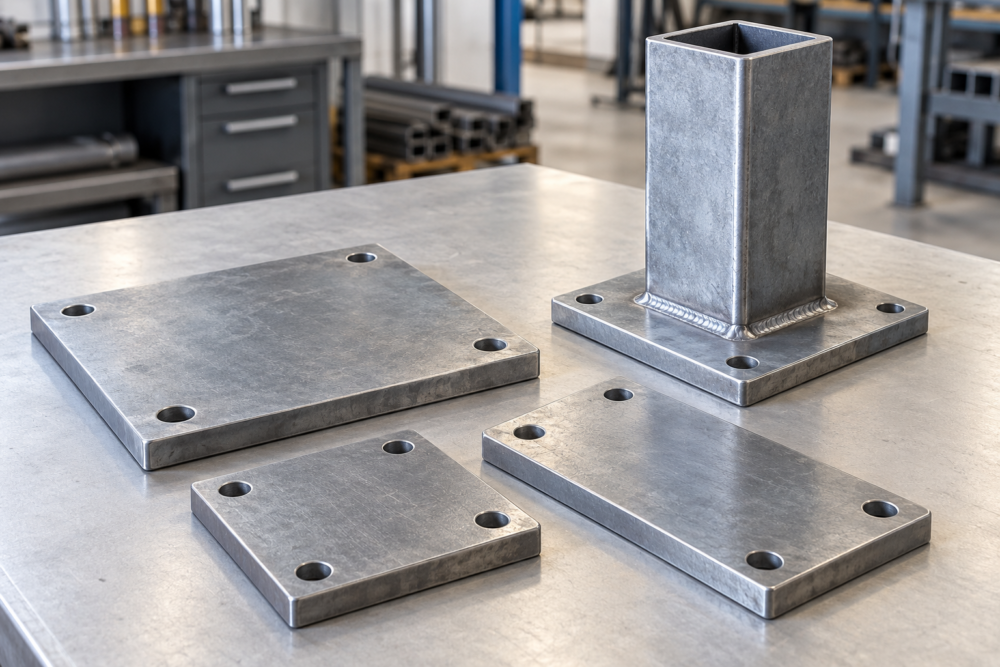
Base plates are important components in many structural and fabrication projects. Positioned beneath columns, posts or equipment supports, they provide an interface between the supported member and its foundation. Their dimensions, material and connection details depend on the intended application.
Although a base plate may look like a simple piece of metal, it forms part of a wider connection. The plate, welds, anchors and supporting surface must work together. Understanding their purpose helps property owners, project managers and buyers ask better questions when reviewing drawings, quotations and fabrication requirements.
What Are Base Plates?
A base plate is typically a flat metal plate used at the bottom of a structural member or support. In steel construction, it commonly connects a column to a concrete foundation through an arrangement of welds and anchor rods.
One of its main functions is to spread forces over a suitable bearing area. However, the complete connection may also need to accommodate uplift, shear or bending, depending on the structural design. Its suitability cannot be judged from appearance or plate thickness alone.
Where Are Base Plates Used?
Base plates appear in building frames, industrial structures, equipment supports and other fabricated assemblies. Their design varies considerably between applications, even when the finished components look similar.
A plate supporting a building column has different requirements from one beneath a lightweight bracket or machinery frame. Similarly, a proprietary post base may combine a plate with other features designed for a particular installation.
Identifying the intended use is therefore the first step. A supplier needs clear information about the application before recommending a product or preparing a fabrication quotation.
Materials and Protective Finishes
Steel is widely used for structural base plates, while other materials may be specified for particular environments or applications. Material selection should follow the project documentation and consider strength, fabrication requirements and exposure conditions.
Protective finishes also deserve attention. Galvanising, paint systems or other specified treatments may be used to address corrosion exposure. The appropriate choice depends on the environment and the complete assembly.
Confirm whether the quotation includes surface preparation, finishing and treatment of fabricated details. A finish should be selected for its suitability, rather than simply its colour or appearance.
Dimensions and Hole Arrangements
Plate length, width, thickness and hole positions all influence how a connection fits together. Anchor layout, edge distances and fabrication tolerances must be coordinated with the supporting structure and installation requirements.
A larger or thicker plate is not automatically an appropriate substitute for the specified component. Changes can affect the connection and surrounding details.
Before ordering, check that the fabricator is working from the correct drawing revision. Confirm dimensions, material grade, hole details and any identification requirements. Resolving discrepancies before fabrication can help avoid expensive alterations or delays on site.
Base Plates and Anchor Connections
Anchors connect the plate assembly to its supporting foundation, but they are only one part of the connection. Their arrangement must be considered alongside the plate, supported member and concrete.
The design may include bedding or grout beneath the plate, depending on the specified arrangement. These details influence how the assembly is supported and installed.
Installation should follow the approved documentation and relevant product instructions. Altering holes, substituting anchors or changing connection details without an appropriate review can create problems that are not obvious during a visual inspection.
Quality Checks Before Installation
Checking components before installation helps identify differences between the supplied items and project requirements. Review the plate dimensions, hole positions, finish and visible condition against the documentation.
For welded assemblies, confirm that the required fabrication and inspection records are available where specified. Damaged coatings, distortion or incorrect hole layouts should be raised before the component is installed.
These checks complement the project’s quality process. They do not replace engineering verification or establish the capacity of a connection by themselves.
Selecting Base Plates for Your Project
Start with a clear description of the application and current drawings. Ask the responsible designer or supplier to confirm the required specifications, fabrication scope and installation information.
Careful coordination helps ensure the base plates supplied match the connection intended for your project.