
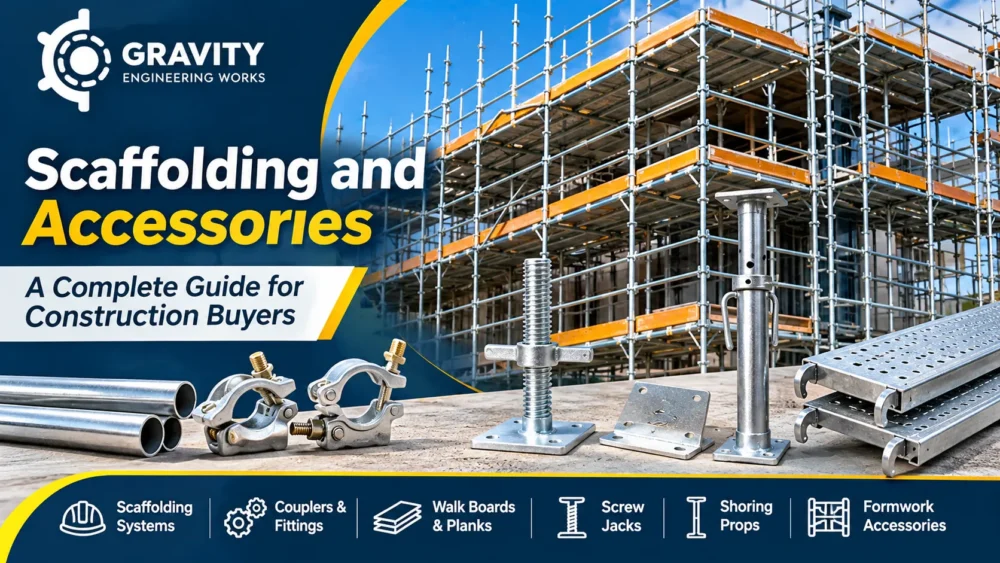
Scaffolding and Accessories: A Complete Guide for Construction Buyers
Good scaffolding access begins with the selection of appropriate machinery. The contractor and the procurement manager have to take into account the structural specifications, compatibility of the parts used, worker accessibility, and maintenance while acquiring scaffold machinery.
The selection of appropriate scaffolding and its accessories may go a long way in avoiding procurement mistakes and efficient project planning.
Whatever the need for scaffolding may be in your construction projects, be it commercial construction, industrial maintenance, or any other infrastructural construction, it becomes important to know about the different scaffolding systems that exist.
What Are Scaffolding and Accessories?
Scaffolding includes temporary elevated work platforms and their supports used for construction, maintenance, and related purposes.
Scaffolding accessories are those components used for joining, supporting, adjusting, bracing, or completing the scaffold assembly. These include couplers, screw jacks, base plates, braces, and working platforms.
The combination of these two creates an access arrangement that is tailor-made for specific project needs. Nevertheless, scaffolding accessories should be selected according to scaffold design instructions.
Types of Scaffolding Systems Used in Construction
Different scaffold systems use distinct connection methods and components. Understanding these differences helps buyers select suitable equipment.
Ringlock Scaffolding
Ringlock systems use rosette-style connection points on vertical standards to connect compatible horizontal and diagonal members.
They offer modular configuration options for suitable construction and industrial access applications.
Cuplock Scaffolding
Cuplock scaffolding uses cup-based locking connections to secure compatible horizontal members to vertical standards.
Its modular design allows different scaffold arrangements, subject to system specifications and engineering requirements.
Kwik-Stage and Other Systems
Kwik-Stage scaffolding uses a system-specific locking arrangement for connecting structural components.
Other options include Twist Lock and frame-based systems. However, these product families should not be treated as interchangeable without verified compatibility.
Gravity Engineering Works lists these categories in its scaffolding product range
Essential Scaffolding Accessories and Components
Selecting appropriate accessories is just as important as choosing the scaffold system.
Scaffold Couplers
Couplings join together compatible scaffold pipes and structural pieces. Right angle and swivel couplings are the types of couplings commonly found but depend on the scaffold structure itself.
Adjustable Screw Jacks
Screw jacks help provide controlled base-height adjustment in supported scaffold arrangements. Their use requires appropriate load-bearing support and installation.
Scaffold Planks and Walk Boards
Planks and walk boards form working surfaces within suitable scaffold configurations. Buyers should verify dimensions, load ratings, material condition, and platform compatibility.
Scaffold Braces
Bracing components contribute to structural stability when installed according to the approved scaffold design.
Shoring Props and Formwork Accessories
Shoring props provide temporary structural support for specific construction activities. Formwork accessories support temporary concrete forming systems.
These products serve distinct functions and should not automatically be substituted for access scaffold components.
How to Choose Scaffolding and Accessories for Your Project ?
Before purchasing scaffolding and accessories, contractors should evaluate several technical and operational factors.
- Component compatibility: Confirm that connections and dimensions match the selected scaffold system.
- Material specifications: Request verified information about construction materials and relevant finishes.
- Load requirements: Establish applicable capacities through manufacturer documentation and the project design.
- Site conditions: Consider foundation stability, working height, access requirements, and environmental exposure.
- Inspection and maintenance: Review procedures for identifying damaged, worn, or incompatible parts.
- Documentation: Obtain product specifications and relevant technical information before procurement.
Mixing components from unrelated systems without appropriate approval can introduce serious safety and performance concerns
Scaffolding Safety and OSHA Requirements in the USA
Construction scaffolds in the US have to comply with the appropriate Occupational Safety and Health Administration standards.
According to OSHA 29 CFR 1926 Subpart L, the regulations on scaffolds are concerned with capacity, platform construction, stability, access, fall protection, and training.
OSHA regulations require the competent person to inspect the scaffolds for visible defects prior to the start of every work shift, and after an event which can compromise its structural integrity.
Occupational Safety and Health Administration
Scaffolds have to be designed by a competent person, and then erected and loaded according to this design.
It is essential to note that OSHA does not certify particular scaffolding equipment just because it is designed for construction purposes.
Why Quality Scaffolding Components Matter ?
Properly defined component characteristics can assist in assessing compatibility and inventory management.
In addition, appropriate material, proper connection details, and documentation will aid in inspection and maintenance planning.
Finally, properly maintained reusable parts may help save costs from repeated purchasing.
Nevertheless, the issue of durability and effectiveness should be assessed based on real product data.
Buying Scaffolding and Accessories for US Construction Projects
The US contractor, distributor, and importer should obtain the appropriate documentation before making the purchase order final.
Ascertaining the correct quantity, product specification, component compatibility, packaging, delivery term, and quotation should be considered.
With regard to imported equipment, customs documentation should also be looked into.
Early discussion with suppliers will determine incompatible components early on.
Explore Scaffolding Products From Gravity Engineering Works
Gravity Engineering Works offers scaffolding products across multiple categories, including Ringlock, Cuplock, Kwik-Stage, screw jacks, couplers, walk boards, and formwork accessories. Gravity Engineering Works
Construction buyers can review the company’s product range and enquire about suitable specifications for their applications.
Looking for scaffolding and accessories for your next construction project?
Explore Gravity Engineering Works’ product range or contact the team to discuss component specifications, quantities, and procurement requirements.
Frequently Asked Questions
1. What are scaffolding and accessories?
Scaffolding includes temporary elevated platforms and supporting structures used for construction access. Accessories include couplers, jacks, braces, and other compatible components. The exact equipment required depends on the scaffold type and project design.
2. What are the most common scaffolding accessories?
Common accessories include scaffold couplers, adjustable screw jacks, base plates, braces, planks, and platform components. Their suitability depends on the selected scaffolding system, manufacturer specifications, and intended application.
3. How do I choose the right scaffolding components?
Review the scaffold design, component compatibility, material specifications, working-load requirements, and site conditions. Request technical documentation and consult appropriately qualified personnel before selecting unfamiliar or potentially incompatible components.
4. What OSHA standards apply to scaffolding in the USA?
OSHA’s 29 CFR 1926 Subpart L establishes construction scaffolding requirements. These cover scaffold capacity, design, access, inspections, fall protection, and training. Additional requirements apply to particular scaffold types.
5. What should contractors consider when buying scaffolding accessories?
Contractors should verify product specifications, compatibility, quality documentation, quantities, delivery arrangements, and supplier communication. Confirm that the equipment is suitable for the intended scaffold configuration and applicable safety requirements.