
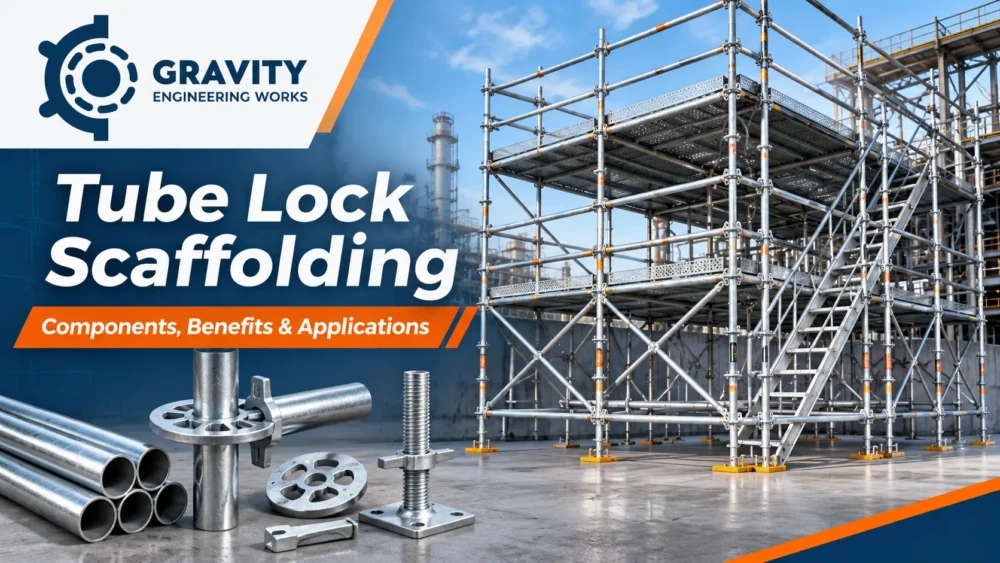
Tube Lock Scaffolding: Components, Benefits & Applications
The selection of appropriate connections is vital to achieve construction access, stability of structures, and planning. For constructors and equipment providers, knowledge of different scaffolds is necessary to avoid compatibility issues and buying errors.
One type of scaffolding is the tube lock scaffolding that is used in construction access systems. Nevertheless, connections and components in tube lock scaffolding systems differ from each other.
Twist Lock scaffolding products are sold by Gravity Engineering Works for those who search for construction equipment to buy. Here you will find information about components in tube lock scaffolding, application, safety, and buying aspects in the USA.
What Is Tube Lock Scaffolding?
“Tube lock scaffolding” means the type of scaffolding whose construction involves the use of the special connection method for locking the tubular members. The locking system varies from one producer to another.
According to Gravity Engineering Works, there is a Twist Lock system involving the clamping connection between the scaffold tubular member and other components. This company offers a Twist Lock Tube Lock component and a Twist Lock Base Plate.
It is important to note that “tube lock” does not necessarily mean Ringlock, Cuplock, or tube-and-coupler scaffolding.
Key Components of a Tube Lock Scaffolding System
The components required for a scaffold arrangement depend on its design and intended application.
Scaffold Tubes and Locking Connections
Tubular parts are elements of the scaffold’s structural support system. Locking mechanisms hold together compatible parts as per the system’s design.
Dimensions of connection, engagement, and installation processes should be in accordance with the manufacturer’s specifications.
Base Plates and Supporting Components
Base plates are used to transmit the loads of the scaffold to the underlying surface. Good foundations and levels are important when using supported scaffolding.
In Gravity Engineering Works, there is a Twist Lock Base Plate included in the list of tube lock accessories.
Bracing and Platform Components
Depending on the approved scaffold arrangement, other equipment that might be included is braces, work platforms, and access methods.
These pieces of equipment need to be chosen in accordance with the entire scaffold arrangement rather than simply because they look nice.
Benefits of Tube Lock Scaffolding for Construction Projects
A properly selected tube lock scaffolding system may offer practical advantages for construction and industrial access.
Connection consistency: Compatible locking components can support repeatable assembly procedures when installed correctly.
Project adaptability: Available component lengths may help buyers plan configurations suited to particular access requirements.
Reusable equipment: Properly maintained scaffolding components may be suitable for repeated use, subject to inspection and manufacturer guidance.
Procurement planning: Identifiable part numbers can simplify ordering, inventory management, and component replacement.
However, assembly speed, structural performance, and cost efficiency depend on the actual product design and project conditions.
Common Applications of Tube Lock Scaffolding
There are various possibilities for which tube lock products can be utilized, depending on engineering feasibility.
These include the use of tube locks in construction, maintenance of buildings, industrial facilities access, as well as in construction infrastructure projects.
For instance, a contractor considering access to building machinery during maintenance work can assess whether there is an appropriate modular system that fits the size and load.
Prior to selection, all relevant details must be established.
Tube Lock vs. Traditional Tube-and-Coupler Scaffolding
Although both systems use tubular components, their connection arrangements may differ.
| Feature | Tube Lock System | Tube-and-Coupler Scaffold |
|---|---|---|
| Connections | System-specific locking mechanism | Separate couplers secure tubes |
| Compatibility | Depends on approved system components | Depends on compatible tubes and couplers |
| Assembly | Follows system instructions | Uses prescribed coupler connections |
| Application | Depends on approved design | Depends on scaffold design and site needs |
Neither method can be considered inherently better. Customers need to evaluate technical documentation, compatibility, availability, and project needs.
OSHA Safety Requirements for Scaffolding in the USA
Scaffold safety is crucial in all stages of its installation, use, inspection, and dismantling.
The OSHA regulates the construction scaffold safety requirements in 29 CFR 1926 Subpart L.
According to section 1926.451, the scaffold equipment should be capable of bearing the load according to the requirements, and it should be inspected by competent persons for obvious defects prior to every work shift and after any occurrence that could impact its structural soundness.
Requirements for specific types of scaffolds are stated in Section 1926.452. These requirements include the requirements for tube-and-coupler scaffolds.
It is not automatic for a specific scaffold product to become certified just because it can be used in scaffold structures.
How to Choose a Tube Lock Scaffolding Supplier ?
US construction buyers should evaluate technical suitability before placing an order.
Important considerations include:
- Verified dimensions, part numbers, and component weights.
- Material specifications and documented performance information.
- Compatibility with existing scaffolding equipment.
- Applicable manufacturing standards and quality documentation.
- Order quantities, lead times, and delivery arrangements.
- Availability of installation instructions and engineering information.
Requesting product documentation early can help prevent procurement delays and unsuitable component selections.
Explore Tube Lock Scaffolding From Gravity Engineering Works
The scaffolding product lines offered by Gravity Engineering Works include Twist Lock components, Ringlock, Cuplock, among others.
Some of the lengths for the Twist Lock Tube Lock product line are from 2 up to 16 feet, providing some listed component options to potential buyers.
When considering components, for American distributors, contractors, and purchasing agents, the first step is making sure that the specifications and purpose of the application are known.
More about the Twist Lock Scaffolding Range or get in touch with Gravity Engineering Works.
Frequently Asked Questions
What is tube lock scaffolding?
Tube lock scaffolding uses a particular locking connection to join compatible tubular scaffold components. The connection design varies between systems, so buyers should verify the manufacturer’s specifications before selecting components.
How does tube lock scaffolding work?
Compatible tubular members are secured using the locking arrangement specified for the system. Correct assembly depends on approved components, installation instructions, structural requirements, and inspection by appropriately qualified personnel.
What are the advantages of tube lock scaffolding?
Potential advantages include standardized connections, reusable components, and flexible procurement options. Actual benefits depend on the system’s design, component compatibility, installation requirements, and intended construction application.
Is tube lock scaffolding suitable for commercial construction?
It may be suitable for commercial projects when the chosen configuration meets engineering, loading, access, and applicable safety requirements. Suitability must be established for the particular project rather than assumed.
What should US buyers check before purchasing tube lock components?
Buyers should confirm component dimensions, material specifications, compatibility, supporting documentation, quantities, and delivery arrangements. They should also verify that the proposed scaffold configuration meets applicable OSHA requirements.